 Chores
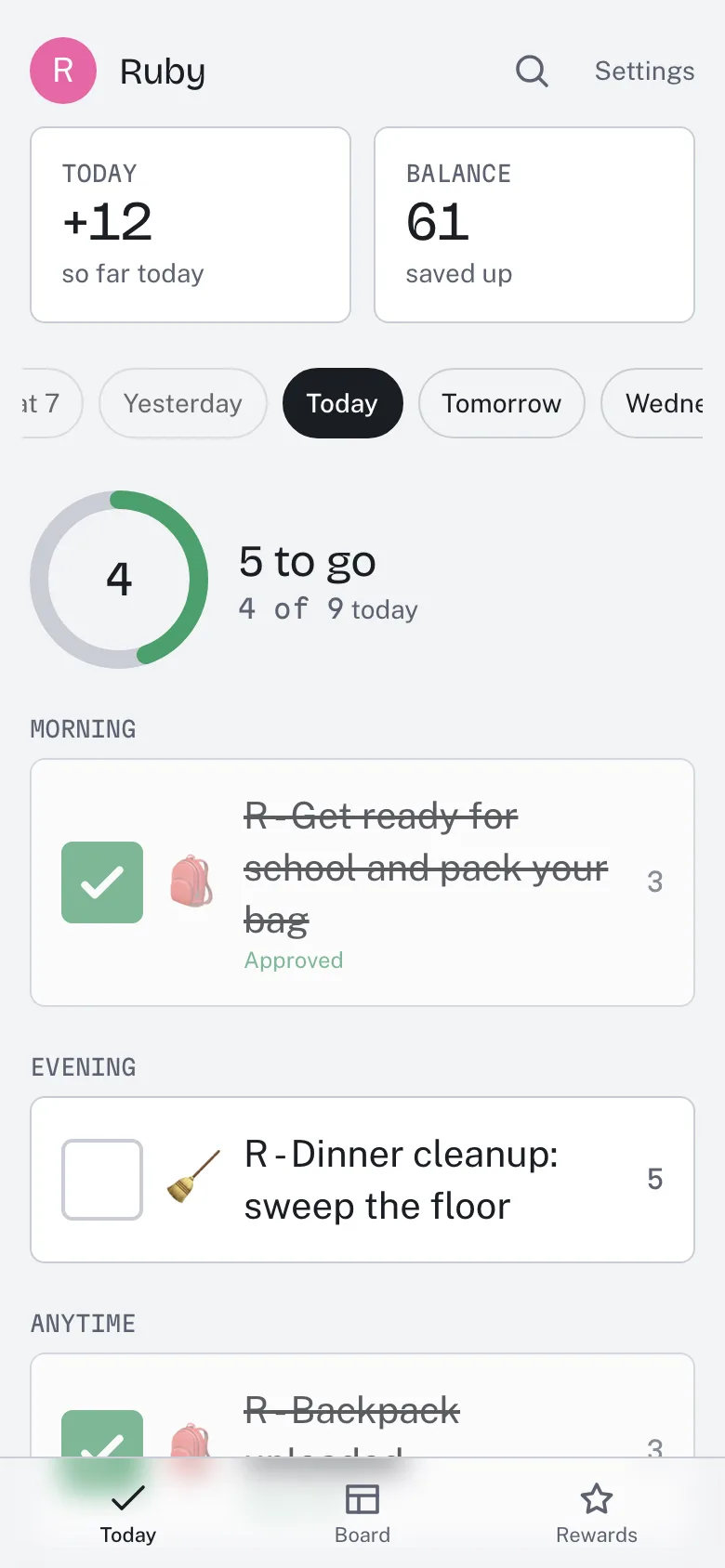
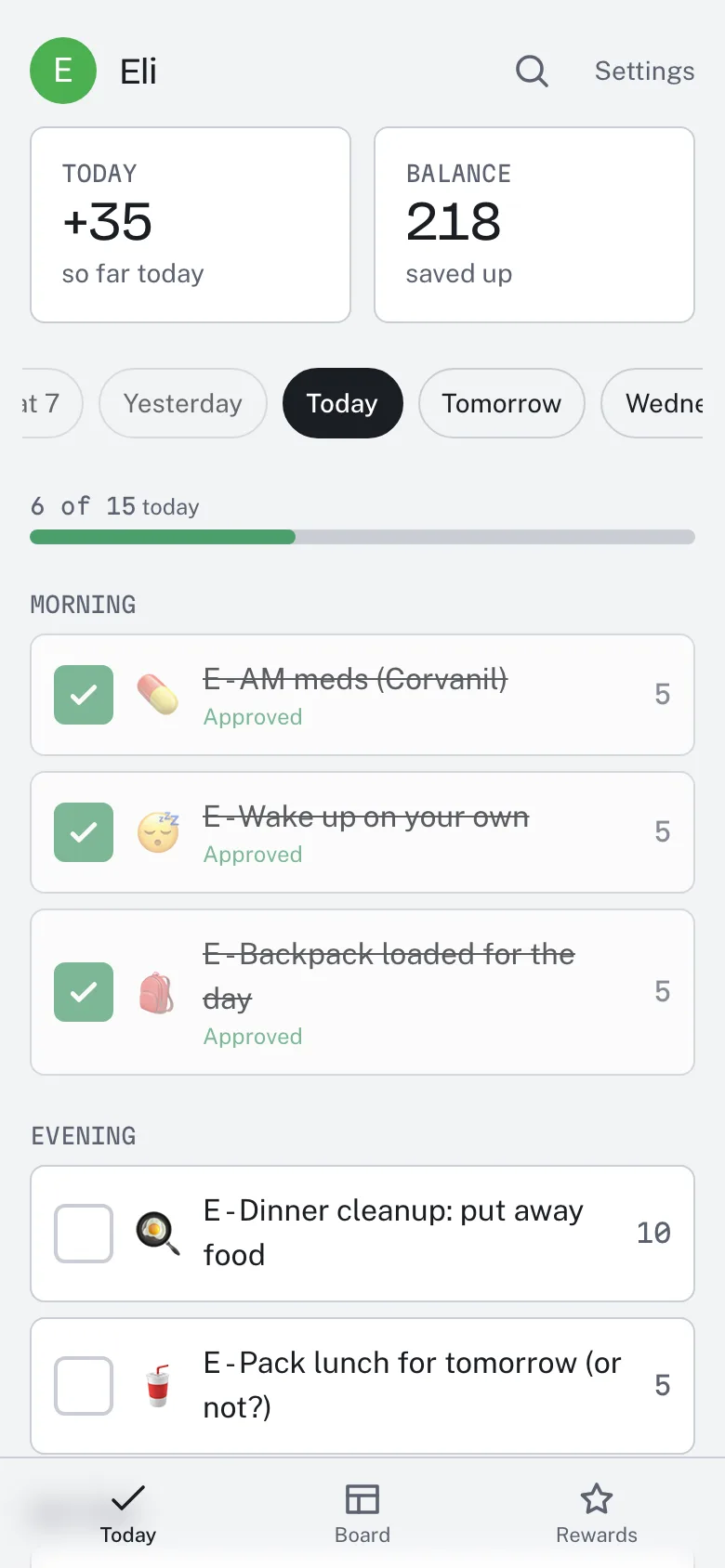
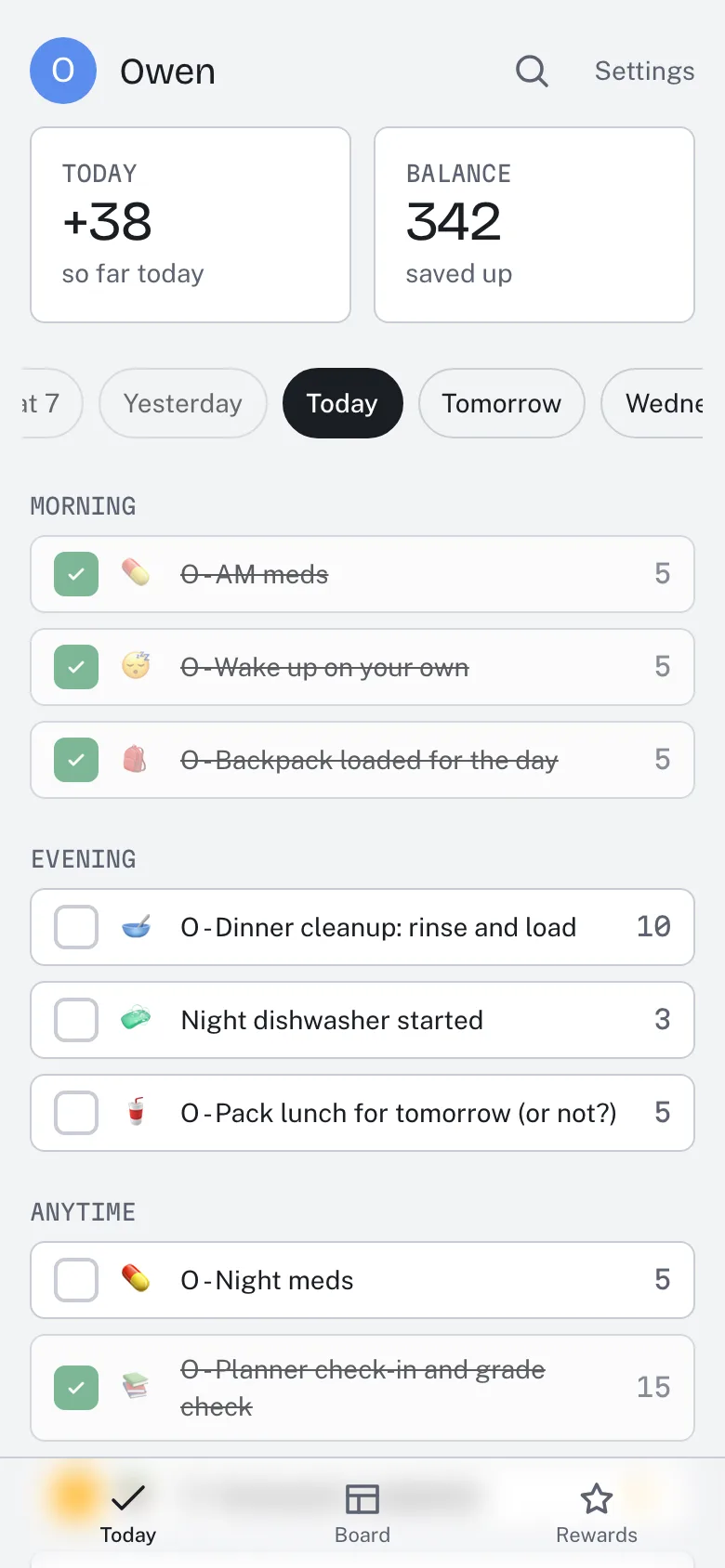
The Hollises are based on a real family, with the names changed. There are two parents and five kids: Owen (16), Eli (13), Nora (10), Jack (8) and Ruby (6). Chores was built for a house like theirs first, and the chart on this page is very close to the one that family uses. The screenshots show the app on an ordinary Monday at about seven in the evening. Breakfast is long over, homework is mostly in, and dinner cleanup has not started.
None of this is the “right” way to run a house. It is one family’s way, with the reasons behind it, so you can see how the pieces fit together and decide which ones suit you.
What they were trying to fix
Before the app, the Hollises ran a paper chart on the fridge and a lot of reminding. The chart worked. The reminding did not scale to five kids. Every chore lived in a parent’s head until a parent said it out loud, so a parent was the to-do list, the alarm clock and the referee all at once.
So the goal was never “more chores.” It was to get the list out of the parents’ heads and onto each kid’s own screen. Then “did you…?” becomes “check your list,” and a parent’s job shrinks to approving what got done.
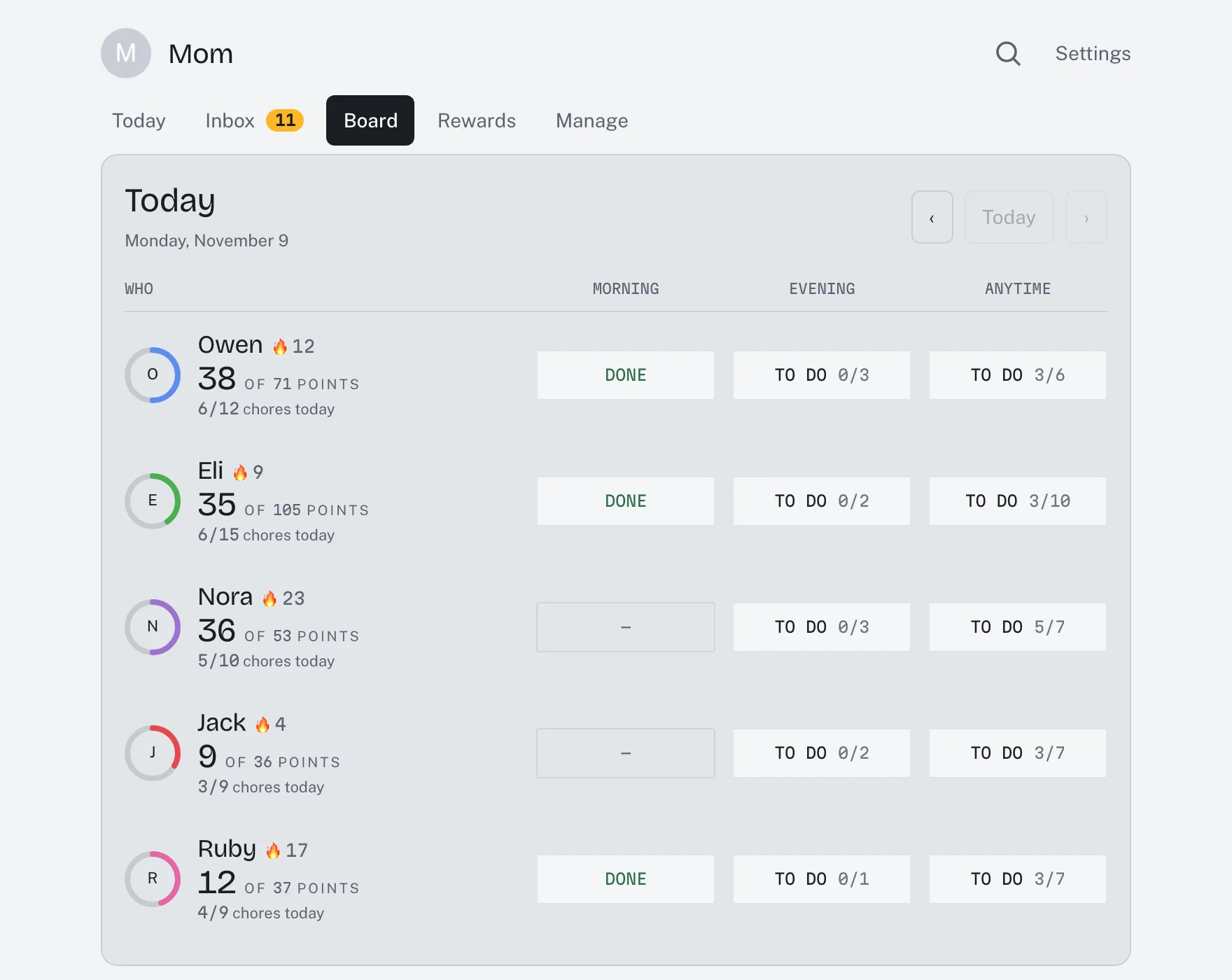
The day has three parts, and each one has a job
Every chore is set to morning, evening or anytime. The Hollises use those three slots to give the day a shape:
- Morning is about getting out the door without help. “Wake up on your own” and “Backpack loaded for the day” are worth points because the hard part is doing them unprompted. Ruby, at six, has one combined morning chore: “Get ready for school and pack your bag.”
- After school is about landing. Backpack unloaded, homework done, and for the two oldest a daily planner and grade check. That last one is the most valuable everyday chore on the chart.
- Evening is the kitchen and bedtime. Dinner cleanup, packing tomorrow’s lunch, and getting to bed.
A kid looking at the app at 3:30 sees exactly what is left for the rest of the day, and nothing from tomorrow.
Every chore has exactly one owner
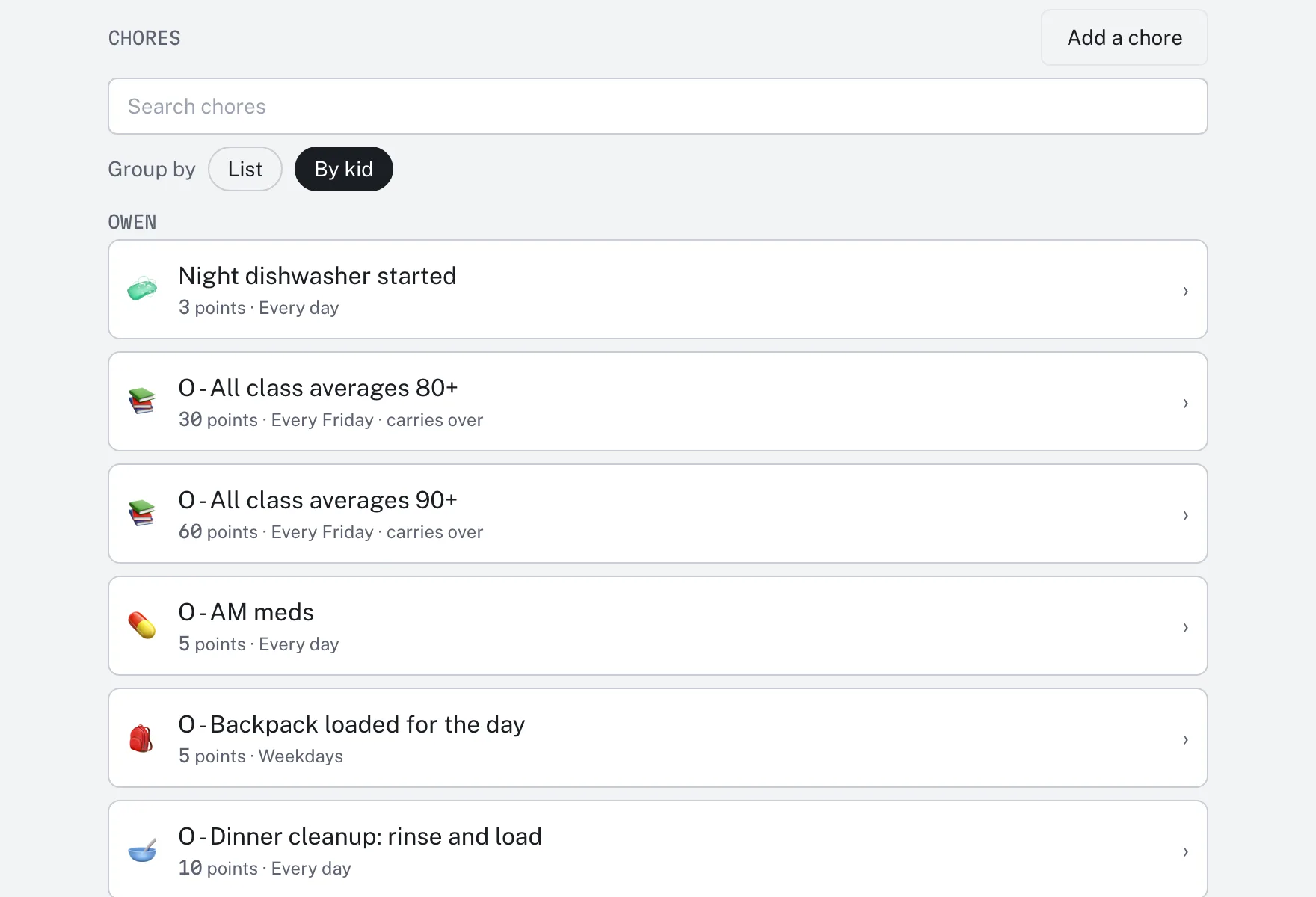
Chores can rotate between kids, but the Hollises barely use that. Almost every chore belongs to one named kid, and recurring chores start with that kid’s initial: “O – Dinner cleanup”, “J – Homework”. Several kids have their own “Homework” and their own “Pack lunch,” and the initial tells a parent at a glance whose is whose. That matters on the approvals screen, in search, and in the full chore list.
One owner means nobody can argue that it was somebody else’s turn.
Dinner cleanup is one job, split five ways
Nobody in this house “does the dishes.” Dinner cleanup is cut into pieces sized to each kid, and everyone has one every night:
- Nora (10) sets the table, then washes the big dishes.
- Eli (13) puts the food away.
- Owen (16) rinses and loads, and starts the dishwasher at night.
- Jack (8) clears and wipes the table.
- Ruby (6) sweeps the floor.
Each piece has an obvious finish line, so “done” is not up for debate. Five small jobs finish faster than one big one, and nobody is left alone in the kitchen.
Try this: take your family’s worst nightly chore and write it as one small chore per kid, each with a clear finish line.
Name the behaviour, not just the task
Some of the most useful items on the chart are not chores at all. “Shower and to bed on time without argument (8:15 school nights, 8:45 weekends)” is on every kid’s list, with the times written into the title and later for older kids. “Wake up on your own” is the same idea for the morning.
Putting the expectation in writing does two things. Bedtime stops being renegotiated every night, because the time is on the kid’s own screen. And “without argument” turns a nightly fight into something a kid can earn.
Medicine is on the list too
Two of the kids take daily medicine, and it lives in Chores like everything else: “E – AM meds (Corvanil)” in the morning slot and “E – Night meds (Corvanil)” at night, 5 points each. Owen has the same pair, plus a weekly one: “Set out your Pellatrex” on Thursday and “Take your Pellatrex” on Friday. (The drug names on this page are made up.)
A few choices make this work:
- It needs a parent’s approval. A tap from a kid says they took it. A parent’s approval says somebody checked. For medicine, the two are not the same.
- Night meds can be ticked off at breakfast. The family lets kids catch up one day. Night medicine is the main reason: the truthful answer to “did you take it last night?” often only comes the next morning, and it should still be recorded.
- The weekly one is worth the most, and it carries over. At 30 points, “Take your Pellatrex” is worth six daily doses. It is the one nobody looks forward to. If Friday slips it moves to Saturday, so a missed dose stays on the list until someone sees it.
- Getting ready is its own chore. Setting the weekly dose out the night before makes Friday easier. For trips, a one-off like “Put your AM and PM meds in the red zipper bag” goes on the list too.
Try this: put each medicine on the list as a morning or evening chore that needs approval. A parent who is not home still sees whether it was taken.
The week has a rhythm too
Repeating chores can run on any days of the week. The Hollises hang their week on a few fixed points:
| Day | What happens | Why that day |
|---|---|---|
| Sunday | Laundry done or put away. The family calendar updated with your week. Ruby gathers and sorts the laundry. | Sunday night is when the week gets planned. |
| Monday | Every kid’s room, plus one shared room each, tidied for the cleaners. Practice records signed, hockey bags packed. | The cleaners come Monday. A cleaner cannot clean what is on the floor. |
| Thursday | Trash to the curb (Jack). Owen sets out his weekly medicine. | The night before pickup. |
| Friday | Bins brought back up. Owen takes his weekly medicine. The grades bonus. | The end of the school week. |
| Weekends | Breakfast dishes and emptying the dishwasher replace the school-day routines. | Different days need different chores. |
The weekly chores are set to carry over. If Sunday’s laundry does not happen, it moves onto Monday’s list instead of quietly disappearing. Daily chores do not carry over, because a missed bedtime cannot be made up the next day.
The biggest points go to steady effort
Most chores are worth 2 to 5 points. Bigger kitchen jobs are 10, and the daily planner and grade check is 15. The biggest numbers on the whole chart are two Friday chores for the two oldest: 30 points if every class average is 80 or above, and another 60 if every one is 90 or above.
That says something about what this family values. A whole week of keeping up with school is worth more than any single job around the house. The daily planner check is what makes the Friday bonus reachable.
Try this: start small chores at 2 to 5 points and keep the big numbers for things that take a week of effort. Inflate points early and every chore after that feels cheap.
A parent’s request becomes a chore
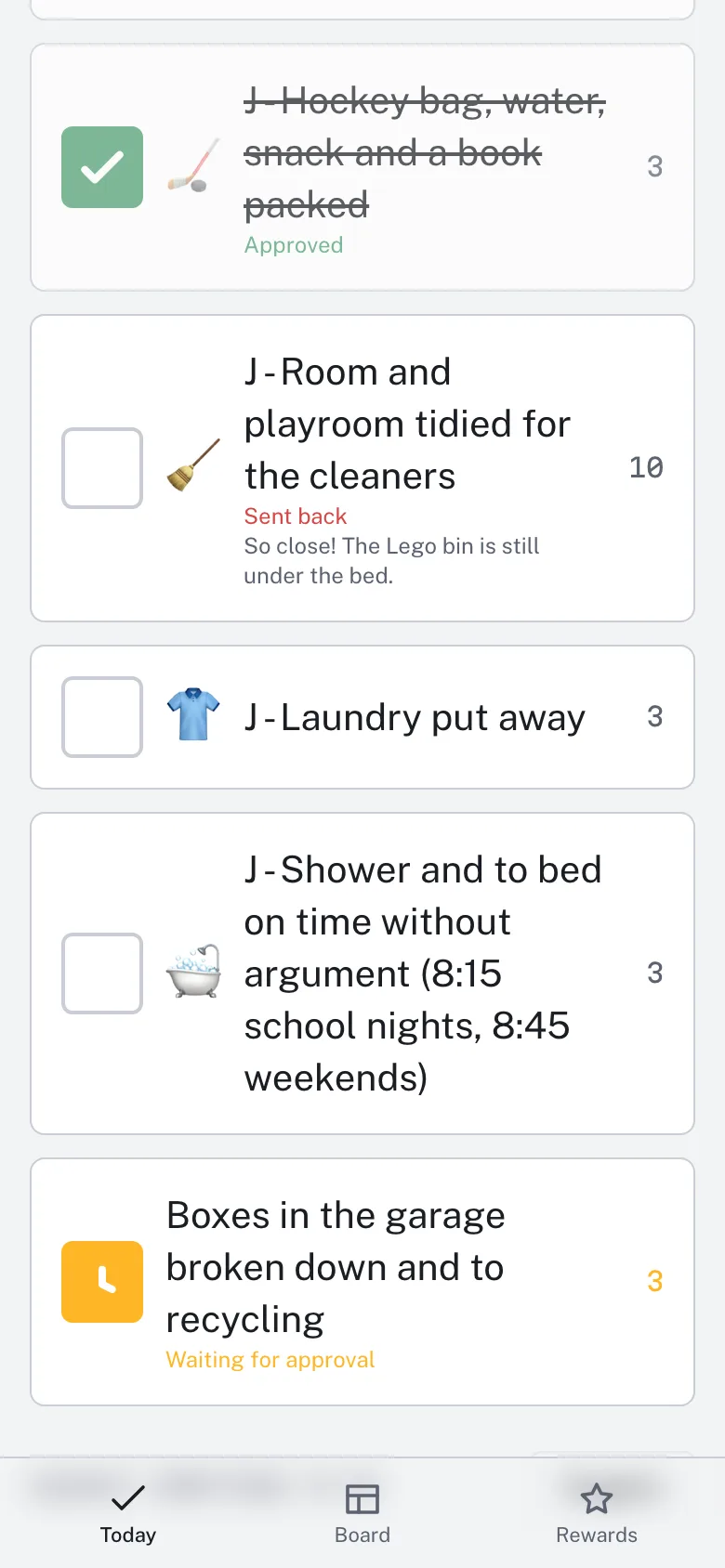
About half of the Hollises’ chores are one-offs: “Boxes in the garage broken down and to recycling”, “Write a note to Grandma”, “Wash your band water bottle”, “Band events on the family calendar”. A parent adds one from the Today screen in a few seconds, for one kid on one day, with a few points attached.
This may be the biggest change from the paper chart. A spoken “can you…” is easy to forget and easy to resent. A one-off chore is written down, shows up on the kid’s own list, and pays.
Approving is a conversation
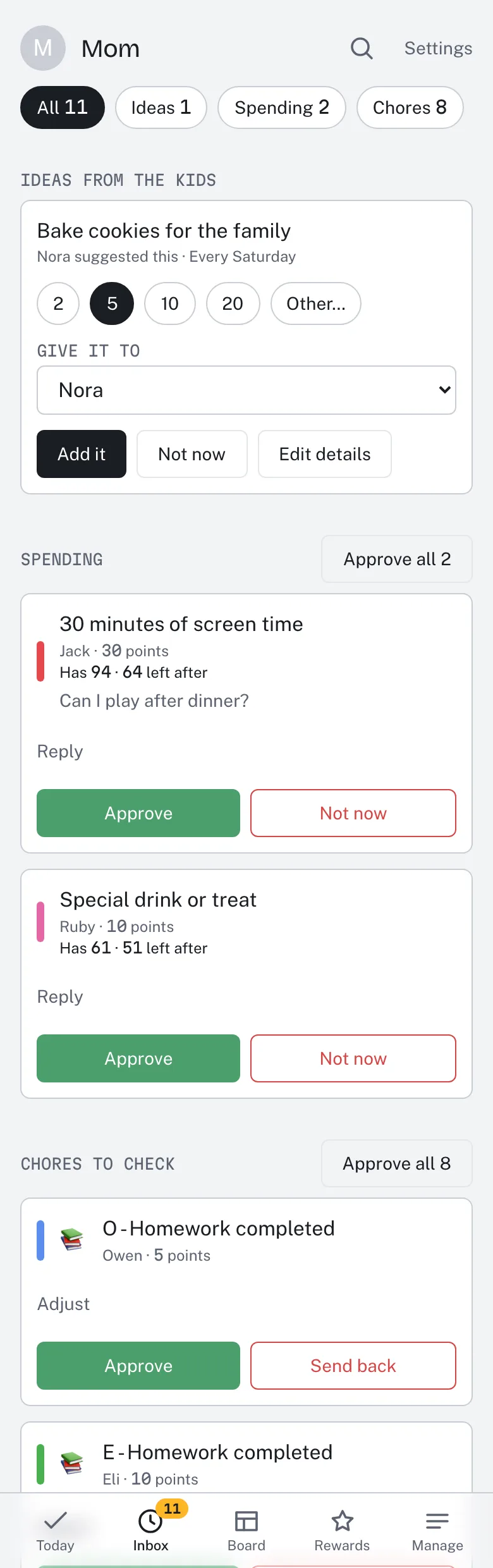
Nearly every chore needs a parent to approve it. A kid taps it done and it waits in the parents’ Inbox, alongside what the kids want to spend points on and any ideas they have suggested. Most evenings that is one pass down the list with “Approve all.”
The useful part is Send back. When Jack’s room is almost tidy, a parent sends it back with a note, and the chore comes back onto his list with the note under it. He fixes it, taps it again, and it counts. There is no lecture and no lost points, just “nearly, here is what is left.”
A few chores skip approval on purpose. Eli’s bedtime chore counts as soon as he taps it. At thirteen, being trusted to report it honestly is part of the point.
Each kid gets a screen that suits their age
The same list can be shown three ways. Ruby and Jack use the playful view, with big buttons and a ring that fills as the day goes. Eli and Nora use the standard list. Owen, at sixteen, uses the plain, dense one. Every kid sees two numbers at the top: what they have earned today, and what they have saved.
What points buy
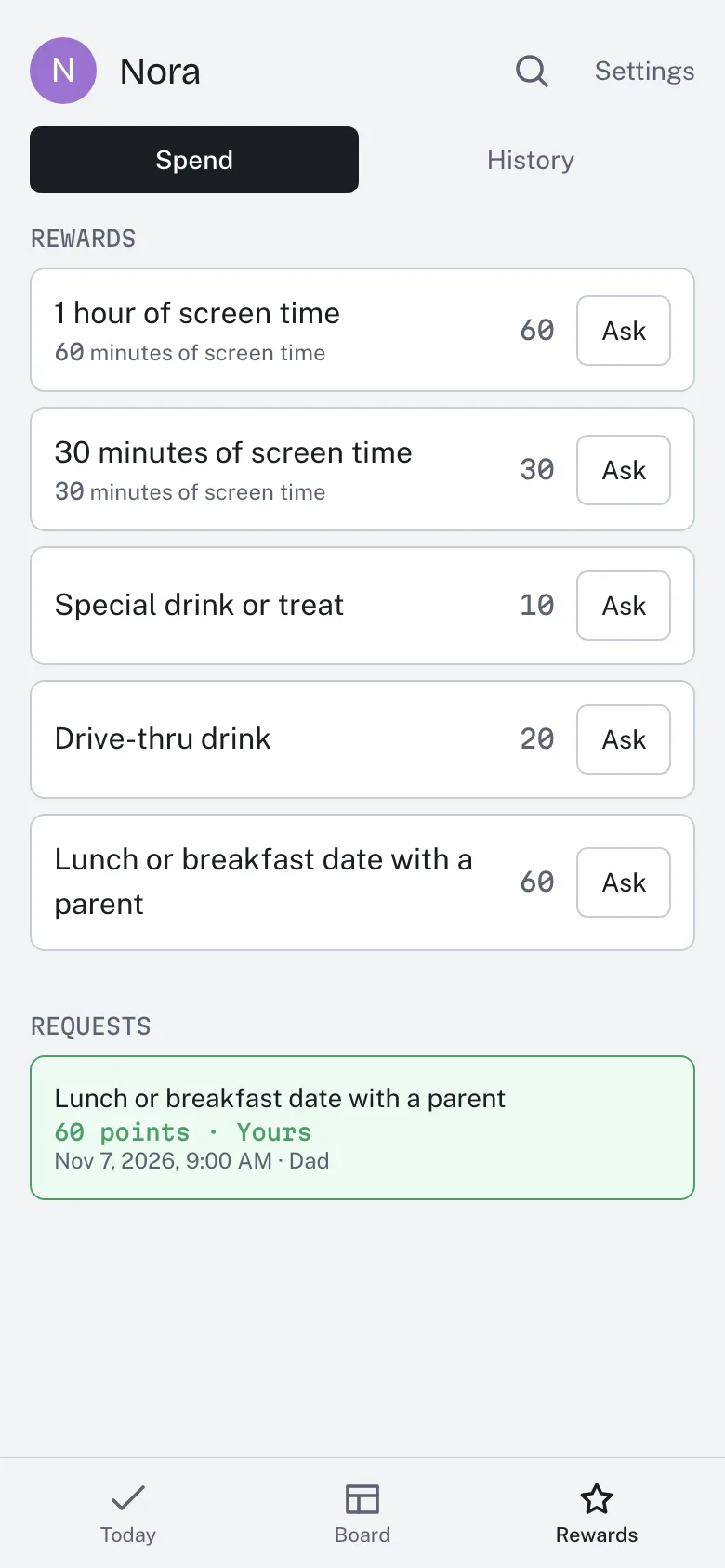
The Hollises keep cash turned off. In this house points are not money, and the allowance is handled separately. Points buy a short list of rewards: an hour or half an hour of screen time, a special treat, a drive-thru drink, and a breakfast or lunch date with a parent.
Screen time is by far the most popular, and that is the design. It is something kids already want every day, so a chore list that leads to it gets used every day. The date with a parent costs the same as an hour of screen time. It gets bought less often, and it is the only reward on the list that is time together.
A kid asks, and a parent approves or says “not now” with a reason, like “not before homework is in.” A no comes with a way to get to yes.
Kids can add to the list
Any kid can suggest a chore. Nora suggested “Bake cookies for the family” for Saturdays. It shows up in the parents’ Inbox, a parent picks how many points it is worth, and it joins her list. The kids do not set their own prices, but they do get a say in what is on the chart.
Small rules that keep it fair
- One day to catch up. An evening chore ticked off at breakfast the next morning still counts, which matters most for night medicine.
- One day to work ahead. A kid can do tomorrow’s chore today, but not next week’s.
- Streaks, with a grace day. The board shows each kid’s run of days, and one off day does not wipe it out.
- Points come from chores. The family turned off ad-hoc bonus points, so the way to earn is the list everyone can see.
- Points never go back. A mistake is fixed with a new entry, not by quietly changing history, so a kid can always see why their balance is what it is.
If you want to set up your house like this
- Write down what you say out loud most often. Those are your first chores.
- Give every chore one owner. Put the kid’s initial at the front of any chore more than one kid has.
- Use morning, evening and anytime to give the day a shape: out the door, landing after school, kitchen and bed.
- Split the worst nightly job into one small piece per kid.
- Write bedtime and wake-up as chores, with the times in the title.
- Put medicine on the list, and make it need a parent’s approval.
- Hang the week on a few fixed days, and set weekly chores to carry over.
- Keep points small, and save the big numbers for a week of effort.
- Turn your “can you…” requests into one-off chores.
- Use Send back with a note instead of a lecture.
- Price rewards around what your kids already want every day, and put time with a parent on the list.
Want to try it? Chores is invitation only. Request an invite, or read how it works first.